
Heat resistance improving monomer (IMILEX™-C)
Nippon Shokubai was the first in the world to commercialize maleimide using its own manufacturing technology.
Find our more
PMMA heat-resistance monomer Research Group of Resin Manufacturer E
Long-standing product enhanced heat resistance, transparency, and scratch resistance
Company E develops, manufactures and sells resin and plastic materials for a wide range of applications. One of their clients, a manufacturer of home appliance parts, approached them with a request to develop an acrylic resin that would match the specifications of a new product.
* This is a hypothetical example posted as a reference for those with similar challenges
Mr. X, a research manager at Company E, receives a call from the sales representative and immediately attends the interview with the client's representative.
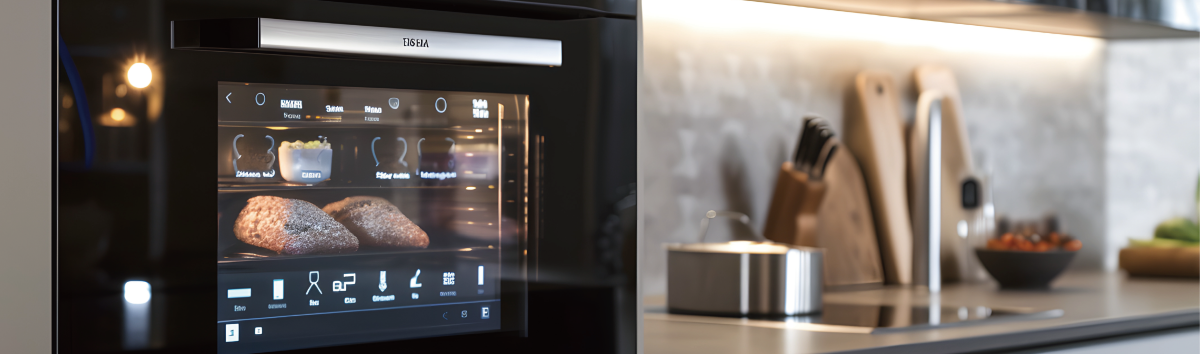
Our client is developing parts for kitchen appliances, and is considering a new product that will improve convenience and interior design by making the operation panel larger and more beautiful. For this reason, they wanted to use acrylic resin as the material for the parts, which is highly transparent and easy to process.
However, cooking appliances are often exposed to heat, which exceeds the heat resistance of acrylic resin, raising concerns that the resin may deform or deteriorate. It was therefore necessary to improve the heat resistance of acrylic resin by more than 20 degrees Celsius.
In addition, the customer's staff also requested that the design be made as scratch-resistant as possible.
First, Mr. X considered blending a highly heat-resistant polymer to improve heat resistance, but he ran into the problem of reduced transparency due to insufficient compatibility.He then decided to consider copolymerizing methyl methacrylate (MMA) with a monomer that improves the glass transition temperature (Tg).
We investigated copolymerization with a styrene-based high Tg monomer, but although this improved the heat resistance of the polymer, it also reduced light resistance, resulting in a new problem of increased yellowing.
Next, we investigated copolymerization with isobornyl methacrylate (IBOMA). The synthesized polymer showed improved heat resistance and maintained its transparency and light resistance, but the thermal decomposition temperature of the polymer tended to decrease.
We have experimented with changing the copolymerization ratio, but we are unable to achieve a balance between heat resistance and other properties.
Mr. X began to feel anxious, thinking, "If this continues, we won't be able to meet the deadlines requested by our clients."
There was a request to develop an acrylic resin that combines heat resistance and transparency for use in home appliance parts.
Copolymerization with various monomers was investigated as a method to improve the heat resistance of acrylic resin, but it was not possible to achieve a balance between heat resistance and other properties.
IMILEX™-C (N-cyclohexylmaleimide) is a heat resistance improving monomer that can effectively improve the heat resistance of polymers through copolymerization.
IMILEX™-C (N-cyclohexylmaleimide), which is suitable for applications requiring optical properties, can maintain the transparency and light resistance of MMA by copolymerizing it with MMA.
Mr. X continued to gather information on monomers that could improve heat resistance, when he happened to be approached by a veteran employee he knew.
"I previously evaluated N-cyclohexylmaleimide called IMILEX-C from Nippon Shokubai Shokubai, and I recall that it was effective in maintaining the heat resistance and transparency of the resin, and there were no concerns about light resistance," he told us.
Mr. X was interested in this idea and immediately contacted Nippon Shokubai. He immediately received a call from a sales representative, who told him about his current problems and arranged a technical consultation.
During the meeting, IMILEX-C was introduced as having a long sales track record, being able to effectively improve the heat resistance of various polymers, and being particularly suitable for applications requiring optical properties.
I am also very interested in the structure of N-cyclohexylmaleimide and the explanation that its rigidity as a polymer increases the hardness of the resin.
After receiving various advice from Nippon Shokubai regarding copolymerization conditions, Mr. X considered copolymerizing IMILEX-C with MMA. The prototype polymer achieved the target heat resistance and also had a good balance of other properties such as transparency and light resistance.
Furthermore, it was confirmed that scratch resistance had improved, and Mr. X felt confident. Company E has decided to present a prototype containing IMILEX-C to its customers, and is currently finalizing the details.