
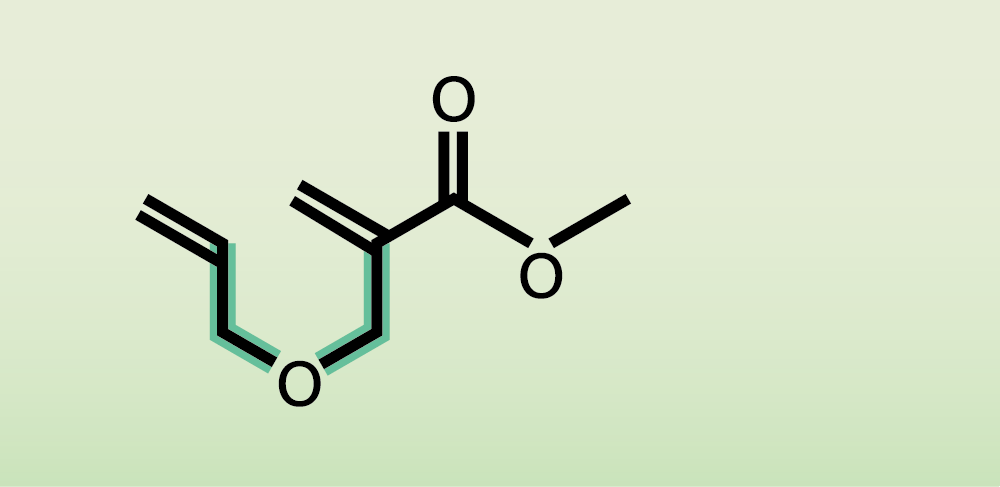
Cyclic polymerizable monomer (AOMA™)
special acrylic monomer
Find our more
Cyclic polymerizable monomer with low viscosity and excellent adhesion properties. Printing Manufacturer Company J, Electronic Materials Research Institute
Improvement of inkjet ejection properties with the reduction of viscosity in QD ink!

Researcher B ( hereafter "B"), who belongs to the electronic materials research institute of printing manufacturer Company J, is in charge of developing functional inks for displays. He received a contact from a representative of a client display manufacturer, who wishes to consult about the development of Quantum Dot (QD) ink for Quantum Dot displays.
* This is a hypothetical example posted as a reference for those with similar challenges
B attended a meeting with the client together with the sales representative. The inquiry from the client was about the new QD ink.
QD ink is adopted in quantum dot displays manufactured by customers, and it has the ability to emit colors accurately and vividly. According to a representative from the client, they were considering the development of a new product and wish to improve optical properties.
B and the others promptly returned to the research institute to discuss the direction of their development as a team. QD ink is produced by dispersing QD particles in a binder resin or solvent. In particular, to enhance optical properties, it is necessary to pattern the QD ink with high precision at targeted locations, meaning that the inkjet characteristics must be improved to allow for clean printing.
Therefore, in order to improve the inkjet characteristics, they decided to proceed with the consideration of reducing the viscosity of the ink. Lowering the viscosity of the ink can enhance ejection stability, the formation of fine droplets, and nozzle reliability.
B and his team focused on polymerizable monomers used in QD ink, particularly considering the reduction of viscosity, which was expected to improve inkjet characteristics.
First, they examined other polymerizable monomers centered around isobornyl acrylate (IBOA), which is commonly used in QD ink. IBOA has characteristics such as high transparency, good compatibility with QD particles, high dispersion, low volatility, and stable ejection in inkjet printing.
On the one hand, there were disadvantages such as low crosslink density and poor solvent resistance, as well as inadequate toughness and elongation, and not very high adhesion to the substrate. Additionally, B believed that there are limitations in terms of reducing viscosity.
From the perspective of achieving low viscosity, they examined several monofunctional acrylates. Although the ink viscosity decreased, there were notable drawbacks such as reduced curing properties, significantly decreased strength of the coating, and lower adhesion to the substrate. Additionally, while some bifunctional or higher acrylates showed a decrease in viscosity, the reduction was insufficient, and due to increased curing shrinkage, it became difficult to achieve high-precision patterning, raising the risk of failing to express the performance of QD inks.
Unable to find a balanced combination, B was at a loss as the deadline for providing samples to the client approached.
A client has made a request to printing company J for the development of Quantum Dot (QD) ink for a new display they are developing.
To improve optical properties, they decided to consider enhancing the inkjet characteristics by reducing the viscosity of QD ink.
Although various combinations of polymerizable monomers centered around Isobornyl Acrylate (IBOA) were considered, a balanced combination could not be found.

The evaluation of the cyclic polymerizable monomer with low viscosity and excellent adhesion properties, 'AOMA™', has made it possible to reduce the viscosity of QD ink.
The formulation of AOMA™ improves inkjet ejection properties and enhances adhesion to substrates, leading to the expectation of high-precision pixel formation.
Reducing the viscosity of QD ink can lead to improved discharge stability, which may enhance yield and result in cost reduction.
B visits the exhibition to gather information in search of development hints. There, he learned that Nippon Shokubai is introducing a product called AOMA, which can be utilized as a polymerizable monomer for display applications.
When B inquired about the details at the booth, he was informed that AOMA has low viscosity and, when blended with ink, possesses high dilution capability and UV curing properties. It was also mentioned that compared to IBOA, AOMA allows for a reduction in ink viscosity. Additionally, the strength of the cured film is high, it has excellent heat resistance, and its adhesion to substrates is improved, leading B to feel that it is a very attractive monomer.
After consulting with the product representative of Nippon Shokubai at the exhibition venue regarding the request for sample provision, he arranged the steps for the AOMA evaluation.
"After conducting the trial, we were able to reduce the viscosity of the QD ink as intended, which is expected to improve inkjet ejection performance. Additionally, by adjusting the formulation, we improved the adhesion to the substrate in the evaluation of dot and pixel formation, which is expected to stabilize pixel formation, reduce defect rates, and suppress QD degradation over time" (B said).
Therefore, they decided to progress from the basic evaluation of QD ink to a pixel-level evaluation of optical properties in the implemented state. In the future, they expected to submit samples according to the client's desired delivery schedule while conducting process and mass production compatibility evaluations. Additionally, B was optimistic about cost reduction due to improved yield achieved by lowering the viscosity of the ink.