
The world's top share of superabsorbent polymers, the originality and ingenuity for 40 years
From improved communication to the use of AI
Nippon Shokubai 's main product is superabsorbent polymer (hereafter referred to as SAP). With the ability to absorb hundreds to thousands of times its own weight in water, SAP contributes to society in a wide range of fields as a raw material for sanitary products such as disposable diapers, ice packs, hand warmers, and even water-retaining materials for gardening, and holds the world's top market share.
Such SAPs were commercialized in 1983. For 40 years since then, we have continued to provide a wide variety of SAPs in response to customer needs while continuing to improve our production and quality technologies. The Himeji Works supports the performance and quality of SAP, exports products worldwide, and has the largest production capacity in Nippon Shokubai.
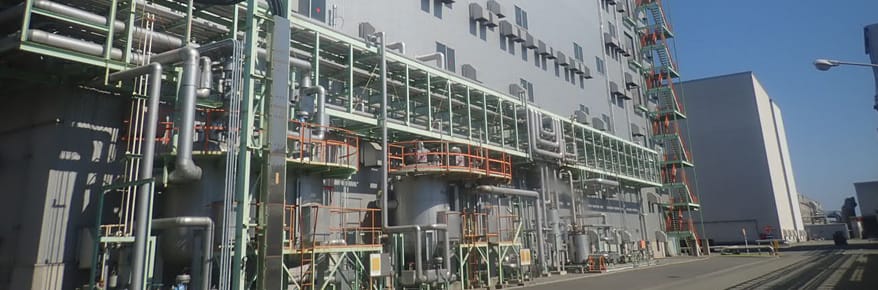
The Himeji Plant is a vast facility with an area of 900,000 m2 (approximately 19 times the size of the Tokyo Dome) facing the sparkling blue Seto Inland Sea. It is engaged in integrated production of SAP starting from acrylic acid, the raw material for SAP. Over 1,000 employees produce the main products every day, with a focus on safety.
Our mission is to provide a stable supply of SAP. To achieve this, we are "promoting data utilization in addition to our extensive experience."
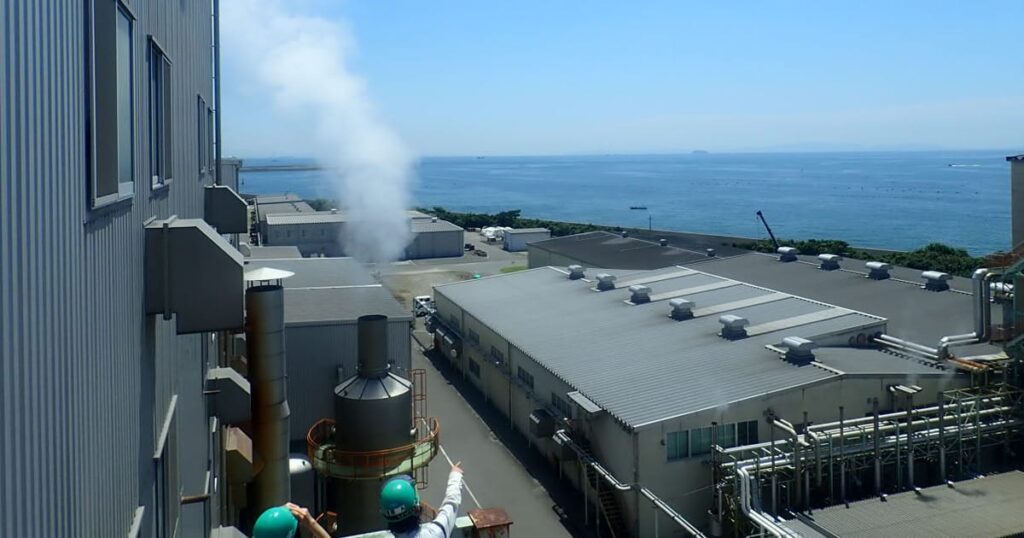
We interviewed three mid-level engineers who work in important departments in the Super Absorbent Resin Manufacturing Division, such as SAP maintenance and new product launches, about their daily work. Their mission is to maintain the equipment in the highly automated manufacturing plant, respond to problems, and build the equipment necessary for new product launches.
"When I perform maintenance on multiple lines, I sometimes feel like a zookeeper because I'm always watching them," says Mr. M, a man in his 30s. Mr. M has been working on SAP since he joined the company and is known as a passionate engineer.
SAP is made through a complex, multi-stage manufacturing process. Temperatures and conditions are precisely controlled at each stage, from the preparation of ingredients to the filling of the product, so numerous adjustments and schedule updates are required at each stage.
He talked about his attitude towards his work, saying, "Instead of just making judgments based on my intuition, such as 'this kind of thing tends to happen on this line,' I also make it a point to check past data. Because our most important mission is to ensure a stable supply of goods, it can be difficult to make decisions when a problem occurs."
Another person in charge, Mr. K, also spoke.
"In order to meet the various requests of our customers, our manufacturing priorities change easily, and we also have to deal with unexpected problems... We want to prioritize product manufacturing, but maintenance activities are also important, so we need to accurately judge what should be prioritized at each stage. Even in such cases, we make sure we can hold discussions based on data from past manufacturing."
SAP's manufacturing technology is still evolving. That's why we help each other through daily communication.
Mr. K continues.
"SAP has a complex manufacturing process and many conditions to control, so it is difficult, but I think there is still room for improvement. Furthermore, because stable production is necessary every day, basic checklist management is not enough. Communication is particularly important in this workplace, so if there is anything on-site that bothers you, I encourage everyone to voice their opinions, even if they are junior."
Mr. O, the person in charge, also spoke.
"We want our junior members to have their own opinions, too, and we want to create an environment where they can speak their minds. We've been discussing this with our mid-level members and trying different things. Recently, we've been trying to create an environment where it's easy to speak up, for example by increasing psychological safety. Younger members won't follow if we just give them specific instructions in a strict manner, so we ask for their opinions before issuing instructions."
"Thanks to that, recently when problems arise, the younger employees have been proactively speaking up and saying things like, 'Wouldn't it be better if we did it this way?' It's really encouraging," said Mr. O happily.
Engineers take over the baton and pass it on to the future of SAP manufacturing
Mr. M says:
"I'm proud to be involved with SAP, our flagship product. That's why we thoroughly test new products when they are introduced, in order to ensure a stable supply. Things don't always go according to plan, so instead of rushing ahead with new things, we gradually introduce new equipment and optimize it. We repeat this process bit by bit... It feels like our technology and equipment are being updated little by little."
At Himeji Plant, Nippon Shokubai 's manufacturing technology is constantly being updated. Here we will introduce a case study of the introduction of a "production planning optimization solution" that uses AI (algorithms) in SAP production planning.
For a continuous and stable supply: Transferring the know-how of experts to AI
We spoke to Mr. Q, the person in charge, about what happened when they considered introducing the "Production Planning Optimization Solution."
"In SAP manufacturing, there are many restrictions, such as different production conditions for each product and the items that can be produced at each plant. For this reason, there were major issues with production schedule creation, such as the increasing dependency on experienced workers. We thought we were reaching the limit of relying on people for this task, so we considered using AI and started this project."
"We were also encouraged by the strong support from upper management, who said, 'We really want you to go ahead with it!' We felt a strong response from the very first simple model verification. We could see the possibility of performance that would surpass that of human labor," he recalls.
The project progressed smoothly thanks to the teamwork of a select few core members within the company. In addition, they were fortunate to have an external partner, and as a result, they were able to achieve implementation in a short period of time, from partner selection to completion in about one year. The production planning know-how that had been handled by a limited number of experienced personnel was gradually transferred to the AI (algorithm), and the accuracy was improved.

Some people commented that rather than the AI learning, it seemed as if the experienced person was teaching the new AI, "In this case, it would be better to do it this way." The AI creates production plans from scratch in areas where there are no conditions set. Therefore, it sometimes proposes plans under conditions that the experienced person would never have thought of, and there were times when they realized their own tacit knowledge, such as when deciding on the timing of switchovers and allocating warehouses.
Using AI has succeeded in streamlining production planning work, making it possible to plan from a longer-term perspective
As a result of various considerations, it was decided that the production plan optimization solution using AI (algorithms) can now create a three-month production plan in just 30 minutes, whereas it used to take an expert a day to create one. Until now, the most that humans could do was to reorganize the immediate plan in response to sudden problems or requests, but now it is possible to reorganize plans from a long-term perspective.
Mr. Q commented on future developments, "SAP has an especially large number of customers, and sometimes we receive sudden requests. Changes to production plans are inevitable, and a stable supply is necessary with these changes as a prerequisite. I believe that this initiative will help with that. I also expect it to be effective in preparing inventory for future regular repairs."
In the past, SAP was focused on absorbing large amounts of water, but it has continued to evolve into a product with added functions. In order to keep up with these changes, many departments at Nippon Shokubai work together to advance SAP manufacturing technology.
SAP is an indispensable part of the daily lives of people all over the world. In order to meet these expectations, we at Nippon Shokubai will continue to evolve every day through the production and improvement activities we have introduced here.