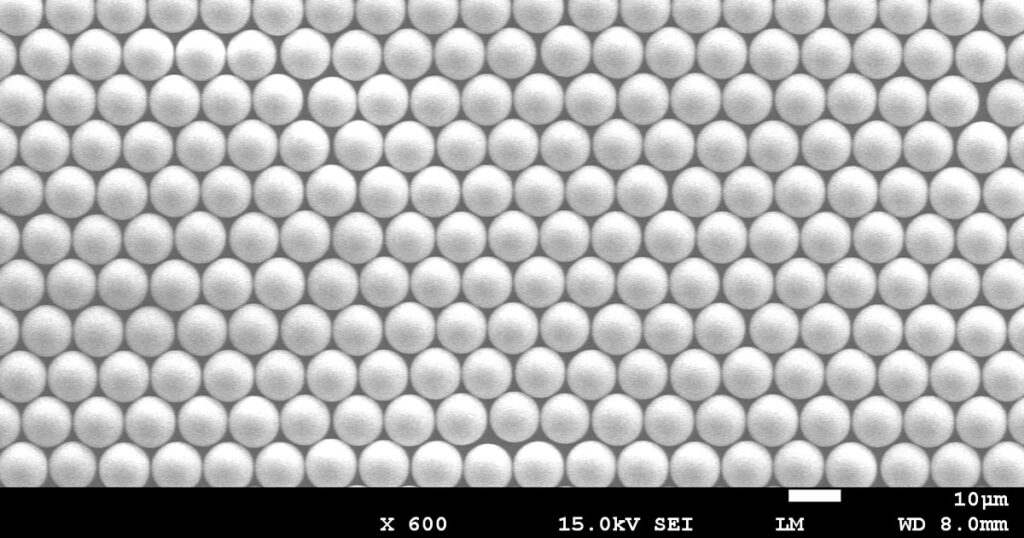
The Story Behind the Innovation: Developing Spherical Silica with Precision Particle Control

This is how Nippon Shokubai 's spherical silica microparticles with controlled particle size were born!
One of Nippon Shokubai 's world-class core technologies is its fine particle technology.
We offer a wide range of inorganic, organic, and organic-inorganic composite fine particles in a variety of particle sizes, from nano to micron size.
Among them, we will introduce the development story of SEAHOSTAR™ KE, which has long been a central part of Nippon Shokubai 's fine particle products since its commercialization in 1987.
Research started from the needs of a major PET film manufacturer
1985 The Central Research Institute's Fifth Laboratory was working on the development of fine particle technology for inorganic materials that were not included in the company's product lineup.
One day, when I visited a major PET (polyethylene terephthalate) film manufacturer and was introducing our newly developed fine particle products, the person in charge asked me, "By the way, is it possible to make spherical silica fine particles using Nisshoku's technology?"
The client was looking for a lubricant for base films for recording media (magnetic tapes), and was looking for spherical silica (silicon dioxide) particles with a uniform particle size.
At the time, there were no spherical silica particles with a uniform particle size, and the performance of conventional silica particles was insufficient.
The team immediately returned to the company and began researching synthesis technologies for silica microparticles. They found a 1968 paper by American scientist Stöber et al. and began experiments based on this technology.
Indeed, when we carried out experiments as described in the paper, we found that it was possible to synthesize spherical silica particles with a certain particle size. However, because the raw materials used were very expensive, it was difficult to commercialize the product as is, so we decided to carry out experiments using cheaper raw materials with similar chemical structures.
This is where the team hit a wall: using this starting material, the hydrolysis rate was too fast, so the particle size reached a certain point and they were unable to synthesize larger particles.
However, after repeated experiments and various improvements to reaction conditions and equipment, we finally became able to control the various particle sizes required by PET film manufacturers, and in 1987 we commercialized our first inorganic fine particle product SEAHOSTAR™ KE-E type.
Mr. T, who was a key member at the time,
"The PET manufacturer that shared their needs with us had a strong desire to start supplying silica microparticle products immediately. In order to meet that schedule, our team did not have enough manpower to scale up the work from the lab to the bench and pilot, so researchers from other laboratories came to help out and we worked desperately. We didn't have time to procure a new reaction kettle to use for the bench equipment, so we repurposed some idle equipment. To prevent impurities from getting in, I polished the surface of the kettle myself with sandpaper before using it," he recalls nostalgically.
In order to expand sales, we tried to expand the range of applications, but there was no significant demand.
Although we were able to commercialize the product after it was adopted by a major PET film manufacturer, most of the demand for E-Type, an ethylene glycol dispersion, was for PET film.
Therefore, in order to expand sales, the team investigated the possibility of powdering SEAHOSTAR™ KE, and in 1989 developed the fine powder SEAHOSTAR™ KE-P type.
This powderization has made it possible to add SEAHOSTAR™ KE to any resin, and we have received sample requests from customers in a variety of fields.
Development of SEAHOSTAR™ KE was transferred from Suita Research to the Technology Department of the Himeji Plant in 1992, but there was discussion about whether to continue selling it as a product.
In fact, although the development of SEAHOSTAR™ KE-P type certainly attracted the attention of various customers, the expected large demand did not emerge. To overcome this situation, we developed the high-purity SEAHOSTAR™ KE-S, aimed particularly at high-quality electronic materials, and launched it on the market in 1999, but this did not lead to the development of new customers, sales volume stagnated, and we were increasingly forced into a crossroads regarding the continuation of our business.
It's finally making a breakthrough, in line with growing global demand for LCD displays!
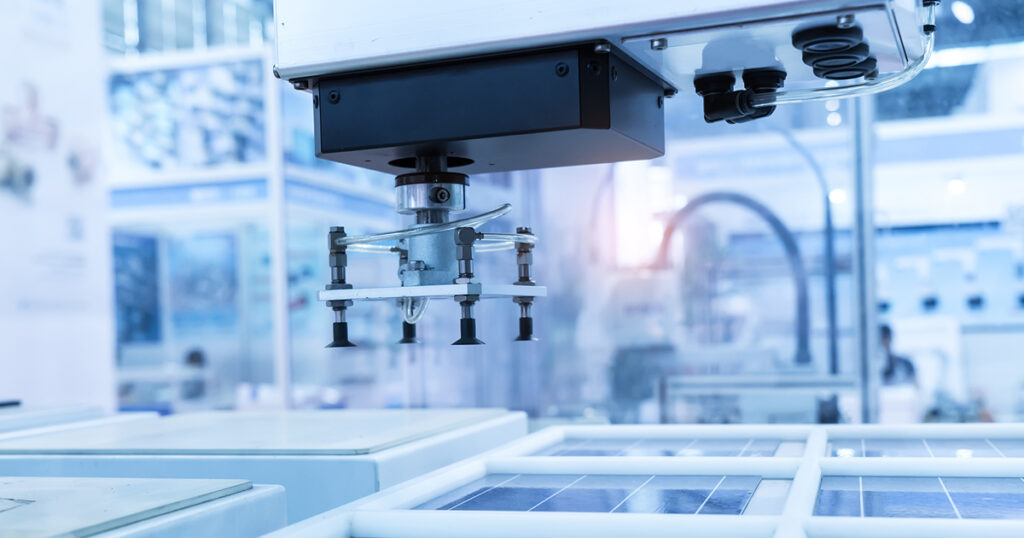
As liquid crystal displays began to attract attention around 2000, the need for larger liquid crystal panels increased dramatically. One of the major issues with the larger size of liquid crystal panels was the method of injecting liquid crystal into the panels. With the conventional method of injecting liquid crystal into liquid crystal panels, it became more difficult to inject the liquid crystal evenly and in a short time as the size of the liquid crystal panel increased. In response to this, the liquid crystal display industry put into practical use a revolutionary method called the ODF (One Drop Fill) method.
However, there was an issue with the liquid crystal sealant used in the ODF method. Silica particles are used as a filler, but there were no mass-produced silica particles that met the required quality, so our company was chosen.
Our company received an inquiry about SEAHOSTAR™ from a sealant manufacturer and delivered the developed product, but was told that minute foreign matter that could only be seen with an electron microscope had been mixed in, forcing us to investigate the cause and take measures. Furthermore, we had to simultaneously establish mass production, which put our team members in a state of hectic schedules. Nevertheless, we managed to get through the situation with the wisdom and ingenuity of the people involved, and by working with the customer to establish methods for managing foreign matter in the product, we were able to continue supplying the product.
Mr. S, who was a key member at the time, looked back and said,
"The production of large LCD displays was expanding rapidly worldwide, and orders for SEAHOSTAR™ were also increasing rapidly from customers. If our supply were cut off, LCD display production lines around the world would come to a halt, so customers begged us to somehow supply them with the required amount, and our team members did their best to respond. However, we were the only company in the world that could supply the required quality in the required quantity, so I think all of our team members worked with a sense of mission to make improvements and supply the product," he said.
A successful product made possible by the researchers' sincere efforts
Mr. T recalls the development of SEAHOSTAR™ KE as follows:
"Even though we managed to commercialize the product in a short period of time, the research institute's higher-ups strongly opposed the project. The reasons for this were that the product was based on publicly known technology from literature, and that the product did not use our own raw materials, so it would not be able to differentiate or be competitive with other companies."
However, the development team, led by the leader, worked with a strong desire to make the project a success.
As a result, SEAHOSTAR™ KE-E has been supplied for PET film applications since its commercialization in 1987.
Furthermore, even when business continuity was in jeopardy, the person in charge fell in love with SEAHOSTAR™ and believed that there would come a time when it would be useful to the world, and it was finally able to match the situation of a major revolution in the LCD display manufacturing process.
This is where customer needs lie, and the passion of our engineers to sincerely respond to those needs has led to the success of SEAHOSTAR™ KE.
Our fine particle technology contributes to a wide range of fields, including anti-blocking agents and slip improvers for plastic films, optical films for LCD panels, light diffusing agents for LEDs, copier toners, and resin fillers.