
Committing Fully to Customers Through SOFC Electrolyte Innovation
Electrolyte Sheet for Solid Oxide Fuel Cells (SOFCs)
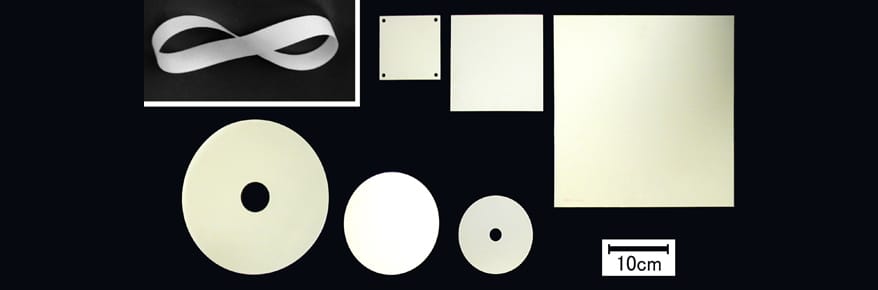
Electrolyte sheet for solid oxide fuel cells (SOFC)
Using our accumulated catalyst technology, we propose solutions tailored to our customers and commercialize them!
Nippon Shokubai supports like-minded customers from the development stage, running alongside them on the path to commercialization. This DNA is engraved in the organization. Continuous improvement in performance and quality, stepping up required performance while reducing costs can sometimes determine the success or failure of a customer's commercialization. This is where our true value as a manufacturer that provides key materials to customers is most tested.
Nippon Shokubai has boasted world-class performance and mass production technology, and expectations are high for the further expansion of demand for clean energy in the future.
Development continues in line with the times...
The Earth Summit was held in Brazil in 1992. Momentum towards environmental protection suddenly increased, and fuel cells were thrust into the spotlight as a new source of clean energy. As the development race intensified between Japan, the US and Europe, the research team at Nippon Shokubai focused on a certain material that forms the electrolyte, a key component of fuel cells. They had been considering using zirconia, a catalyst technology they had developed over many years, when they learned that it would be used as an electrolyte material.
Once we developed zirconia sheets for SOFCs, we were adopted as partner companies by a number of customers both in Japan and overseas. However, our joy was short-lived, as sales volumes did not increase for many years and a difficult period followed.
The reason for this is that the equipment manufacturers who were our customers were having a hard time getting their business off the ground. Fuel cells are a collection of technologies that require fine-tuning,
- Achieving power generation performance and equipment reliability takes a huge amount of time and money
- Although the zirconia sheets they provide are satisfactory, the overall quality of the equipment they are used in is not improved.
- The development of the crucial fuel cell market is progressing very slowly
As a result of these circumstances, all of our clients were forced to slow down their business development.
The year 2005 was when the yellow light came on for the business of our last remaining client. Twenty years had already passed since the start of development of the zirconia sheet, and people within the company began to whisper the word "withdrawal" as a common fate for new businesses that do not blossom for many years.
A single email leads to a loving relationship
At that time, he received an email from the West Coast of the United States requesting the provision of samples. Upon investigation, he found that the recipient was a venture company with 10 employees that he had never heard of. Nevertheless, sales representative I decided to contact them and hear more about their business. After many exchanges, he gradually became strongly attracted to their business vision. "It was like I fell in love at first sight. And those feelings of love never faded for many years afterwards, and they only grew stronger every time I met them," he recalls.
However, the reaction within the company at the time was lukewarm. With a growing mood of withdrawing from the business, there was no enthusiasm for providing a prototype, which would require a lot of work, to an American venture company. Mr. I somehow managed to persuade the company to make a small number of prototypes and wait for the customer's evaluation. One day, a year after the first exchange, he received the news that the first hurdle had been overcome, along with a grand business plan for the future.
"The content of their proposal was a vision for development speed and business expansion that was clearly on a different level from the domestic and overseas customers we had worked with up until then. We had no choice but to invest resources in them from the top down to achieve the quality of the zirconia sheets and the mass production technology that they demanded. However, although we were confident that this customer would definitely grow, unfortunately it was an unknown venture. I couldn't get approval within the company based on my own intuition alone. I felt that we were in a dilemma."
After much deliberation, Mr. I approached the then Managing Director in charge of research and asked him to fly with him to Silicon Valley to meet the company's founding president. As expected, the meeting between the top executives was a great success. Both of them had research backgrounds, and they shared their passion for new businesses and visions for the future, and they hit it off within the first few hours of meeting.
After the meeting, we began a wholehearted relationship with this venture. We made multiple prototypes at a dog-year pace, and a year later we had a completed prototype. We continued to work together to collect data and conduct repeated verification in order to achieve the high specifications required for the core components of fuel cells. We also built inspection methods and automatic inspection equipment for the seats from scratch, anticipating demands for product quality. Furthermore, we invested in facilities almost every year to increase our mass production and supply capacity. Our response exceeded their expectations, supporting them through the most difficult period of commercialization, and we won their complete trust.

Looking back, Mr. I said, "Firstly, what made this seemingly impossible challenge possible was the advanced material forming and firing technology that our company has developed over the years. We couldn't have achieved this without this foundation. Secondly, when we worked with a customer who we had a mutual interest in and fell in love with, from development to mass production, we demonstrated our incredible strength through collaboration across departments. This is the DNA of our organization."
What solutions does Nippon Shokubai propose to its customers?
Mr. I added that this is just his personal opinion.
"I have come to feel that what we value most at our company is empathy, the ability to sympathize with our customers. We put ourselves in the customer's shoes and engage with them with all our heart and soul. Because we put all our heart and soul into it, we often end up working one-on-one with customers, often for long periods of time. The more core our products become for our customers, the more important it is for us to have stable pair work based on mutual trust. The solutions we can offer to our customers are not just the performance and quality of our products, but in fact, the partnership itself."