
From Research to Market: A Dual-Functional Monomer with Acrylate and Vinyl Ether Groups
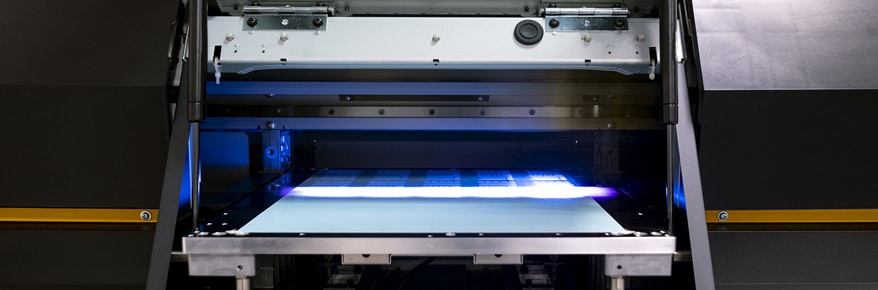
This is how the polymerizable monomer that contributed to the global expansion of UV-curable inkjet technology was born!
Since the successful industrialization of acrylic acid using propylene direct oxidation technology in 1970, acrylic acid and acrylic acid derivatives have been the mainstay of Nippon Shokubai business.
We have produced acrylic ester monomers with a wide variety of structures, contributing to a variety of industries.
In this article, we will introduce the development story of VEEA™, a monomer from Nippon Shokubai that has made a major contribution to technological innovation in the UV inkjet ink market, which has continued to expand since its inception in 2004.
Research that began with a researcher's new idea

In 2000, Mr. Y, who was a member of the Fundamental Technology Research Institute's Second Laboratory, came up with the idea of developing a new acrylic ester monomer that had a vinyl ether group in its molecule. At the time, a neighboring laboratory was conducting research on vinyl ether compounds, and Mr. Y hoped that since the molecule had different polymerizable functional groups, by selectively polymerizing one of the functional groups, it would be possible to synthesize an ultra-high cross-linking agent that possessed multiple radically polymerizable or cationic polymerizable groups.
The synthesis study in the experiment progressed smoothly, and when the properties of this monomer were confirmed in the laboratory, it was found to have low viscosity and excellent dilutability. It was also discovered that the vinyl ether group could be polymerized using only a radical polymerization initiator, confirming its great potential as a reactive diluent for UV-curable inks and other applications.
However, several problems arose during the scale-up stage. Despite repeated countermeasures, problems continued to arise, and some within the laboratory questioned whether the research should continue, asking, "Can we really produce this monomer? Wouldn't it be better to halt the project?"
However, Mr. Y and his team continued to work with the belief that if they could manufacture the monomer properly, it would definitely be a saleable product. As a result of their efforts, they were finally able to prepare sample work and began providing samples to customers.
Although the performance is evaluated in the unexpected SNUR classification...
Since around 2004, we have been providing sample work to customers in Japan, the US, and Europe, VEEA™ has received extremely high praise for its UV curing properties and dilutability as an ink agent.
Mr. G, who was in charge of market development, felt that this evaluation was a sure sign of success.
However, when an application was submitted to the US Toxic Substances Control Act Chemical Substance Inventory (TSCA) in order to sell the product overseas, VEEA™ was classified as an SNUR (Significant New Use Rules) product during registration.
At the time, there weren't many cases classified as SNUR, so the members were quite shocked when they learned this.
Mr. Y and Mr. G went to the Washington headquarters of the EPA (U.S. Environmental Protection Agency) to protest the SNUR classification, but the EPA officials refused to take them seriously, saying that the classification was not serious enough to restrict the sale of VEEA™.
Even so, Mr. Y and Mr. G were desperate because they believed that being given a SNUR would be fatal for VEEA™. Feeling like their business was at its worst, they persistently negotiated with the authorities and succeeded in getting the conditions relaxed.
However, the SNUR rating made it difficult for Mr. G and his team to develop the market. Customers who had previously given VEEA™ high marks suddenly became reluctant to adopt it.
Mr. G and his team continued to visit each customer, mainly in Europe and the United States, to raise awareness of SNUR. Unable to receive any positive responses from customers, the usually mild-mannered Mr. G grew increasingly frustrated, to the point that he was so desperate that he almost threw his PC into the Seine River in a rage in Paris.
With the global spread of UV-curable inkjet technology, the light is finally shining
Since around 2008, the printing industry has been actively working to comply with VOC regulations worldwide, and UV-curable inkjet technology has been attracting increasing attention, particularly in Europe.
With the growing demand for higher quality printing in UV-curable inkjet technology, the need for reactive diluents that can lower the viscosity of inks has rapidly increased, and VEEA™ has gradually become more popular among customers.
Furthermore, around 2012, a major technological innovation in industrial inkjet heads was proposed, and this technology began to spread for high-resolution images, which led to major changes in the required specifications for inks compatible with these heads.
Ink manufacturers have been considering developing UV-curable inks that meet the required specifications, but have not been able to achieve low viscosity inkjet inks when ejected.
In contrast, VEEA™ allows for the production of ink with extremely low viscosity without compromising UV curing properties, and when combined with a high-resolution inkjet head, it is possible to eject small droplets in the picoliter range, enabling the realization of high-resolution images.
This feature was well received by customers, and combined with Mr. G's and his colleagues' steady educational efforts to deal with SNUR, adoption finally began to spread.
Success brought about by the sincerity of those involved
Mr. Y recalls the development of VEEA™ as follows:
"I myself was determined to make it a success, but it was only possible thanks to the cooperation of so many people. I realized that this is a company where if you work hard at research and development with conviction, many people around you will support you even when you encounter difficulties."
Mr. G, who was in charge of market development, also recalls:
"Sales volume did not increase quickly after the product was launched, and VEEA™ faced strong opposition within the company. It received positive reviews from VEEA™ and had many fans. However, sales volume did not increase easily, and executives sometimes teased me, saying, 'You keep saying VEEA™ is interesting, but it just won't sell.' Even so, I believe that I was able to overcome the difficulties by being enamoured with the performance of VEEA™ and by being able to act with a positive attitude even in difficult circumstances."
The researchers' strong desire and the efforts of the sales staff to respond to that desire led to the success of VEEA™.
Our VEEA™ contributes to a wide range of fields, including inks for various printing methods, including inkjet printing, coating agents for plastic films, and optical pressure-sensitive adhesives.