
Revolutionizing Ethyleneimine Production
This is how the ethyleneimine manufacturing process, which is unique in the world to Nippon Shokubai, was born!

The world's first established ethyleneimine manufacturing technology
Nippon Shokubai 's ethylene oxide business has a history of over 60 years since its launch in 1959.
One of the reasons we have been able to continue one business for so long is that we have produced many unique derivatives from ethylene oxide. As a company, we have continued to focus on our own technology under the slogan "A company built on technology," and in that time, we have a history of accumulating the efforts of researchers with solid knowledge and passion.
"The most important thing for a researcher is to never give up"
-- Mr. T, who developed a groundbreaking manufacturing process for ethyleneimine, was one such researcher.
The technology is established, but commercialization is abandoned
At the time, ethyleneimine was one of Nippon Shokubai most promising products, having been successfully commercialized by our company in 1969, as a high-value-added product with a wide range of applications.
However, the liquid phase manufacturing process used at the time had a major problem: it actually produced large amounts of waste liquid.
The Kawasaki Plant therefore wondered if it could somehow switch to a manufacturing process that would not produce waste liquids for the production of ethyleneimine, for which demand was on the rise, and asked the Central Research Institute's synthesis laboratory to develop such a process.
In 1985, a project team was started, consisting entirely of young researchers in their 20s and 30s, led by Mr. T.
By repeating the experiments day after day, Mr. T developed a groundbreaking catalyst for the dehydration and cyclization of monoethanolamine in the gas phase, and devised a gas-phase process using this catalyst.
After that, development progressed smoothly, and two years later, in 1987, bench tests were conducted at the Kawasaki Plant. However, it was discovered that there was a large loss of monoethanolamine recovery in the unreacted monoethanolamine collection process, which resulted in a significant increase in costs, and the bench tests were unfortunately put on hold.
As a result of the investigation, it was found that the cause of the recovery loss was that the carrier gas used to keep the amine concentration constant turned into mist during the collection process. However, the specific solution to this problem was unclear.
Mr. T was feeling depressed and was packing his bags to return to Osaka. At that moment, an idea suddenly occurred to him. It was about the reaction conditions for gas-phase dehydration without using a carrier gas.
Mr. T considered the experiment contents on the Shinkansen to Osaka, and hurriedly carried out the experiment when he returned to Suita. He immediately reported the situation to his superiors, who in turn instructed him to resume the bench test.
Mr. T returned to Kawasaki and resumed his testing, where he successfully solved the problem and established the technology.
After overcoming several obstacles in pilot tests, the decision was finally made to commercialize the project in 1988.
However, the business division decided that it was not possible to change the manufacturing process.
The reason for this was that the capital costs for the developed process were high, utility costs were high, and in addition, the company had recently made an investment in a liquid phase method to increase production capacity, which made it impossible to recover the investment in a short period of time.
Looking back on this time, Mr. T says, "Our mistake was that we didn't share our manufacturing cost targets, including depreciation, with the business division. But I still had doubts about what had become of the significance of the waste liquid reduction that the original manufacturing site had requested."
Management decision puts research results back in the spotlight

Although the project was discontinued, the research results that the researchers had worked out over a long period of time were by no means wasted.
In June 1989, Mr. T and the Kawasaki plant manager were called in by the president to discuss a new ethyleneimine process.
At that time, Mr. T was asked by the president if he wanted to commercialize the technology he had developed.
When Mr. T answered, "Of course I would like to," the president told him that the conditions for corporating the business were to halve equipment costs and reduce utility costs.
The project team then resumed work, embarking on an unprecedented challenge. With ideas such as eliminating the crude monoethanolamine distillation column, the pilot plant was modified and they successfully achieved their goal of cutting capital costs in half.
The facility was completed in October 1990. After a trial run, the world's first ethyleneimine production through a gas-phase reaction finally began.
This process was a world first, and for this research Mr. T later won the Chemical Society of Japan Award and the Catalysis Society of Japan Award.
Our ethyleneimine is used as a raw material for EPOMIN™ (polyethyleneimine), POLYMENT™, Chemitite®, and other products, and these products continue to contribute to a variety of fields.
Ethyleneimine was created by one researcher who failed many times but never gave up until the very end.
Nippon Shokubai will continue to forge ahead with research, development and manufacturing based on this spirit.
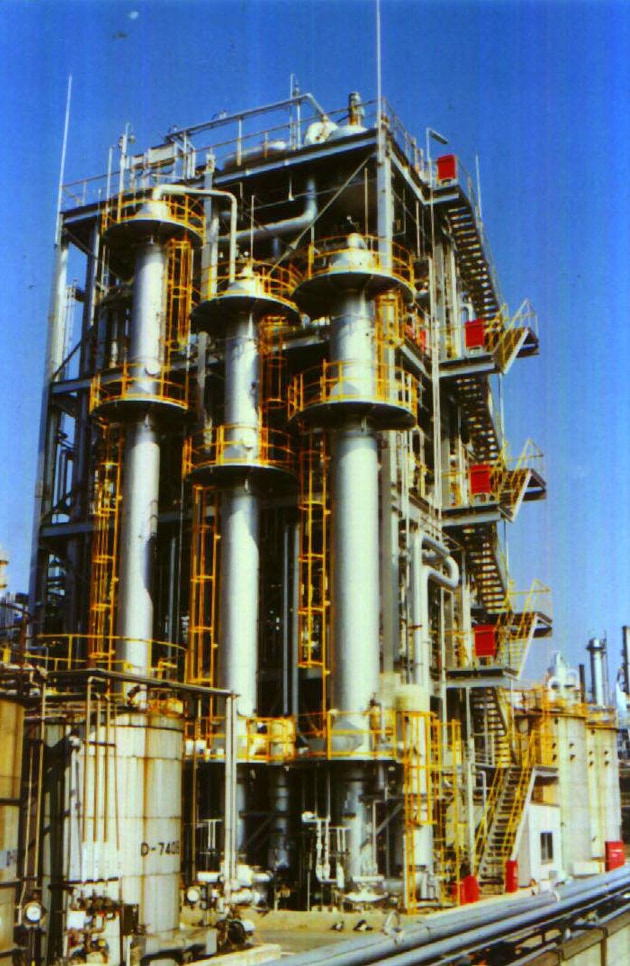
(Photo from that time, still in operation today)