A Comprehensive Guide to Acrylic Emulsion from Basics to Applications!
What is Acrylic Emulsion?
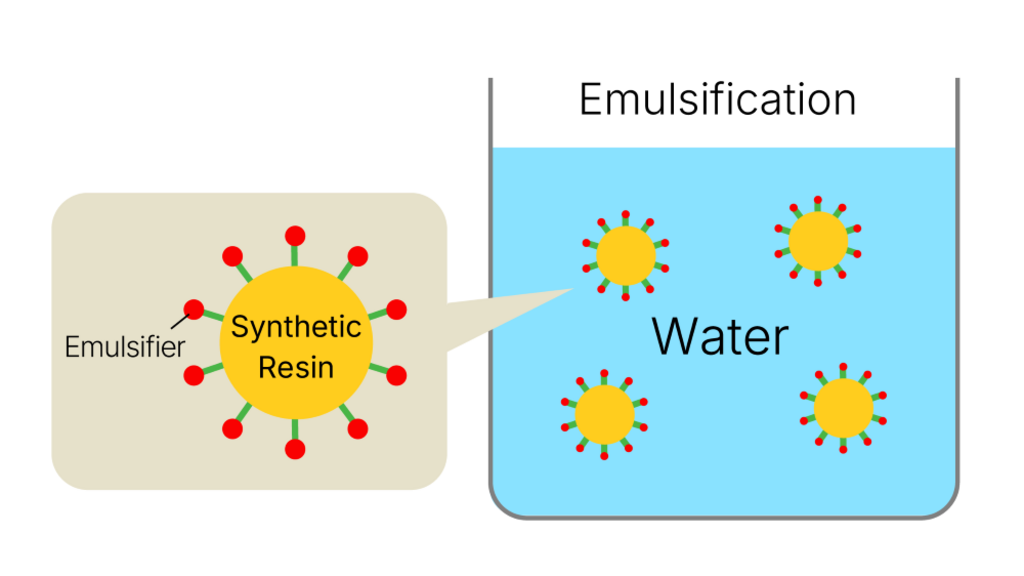
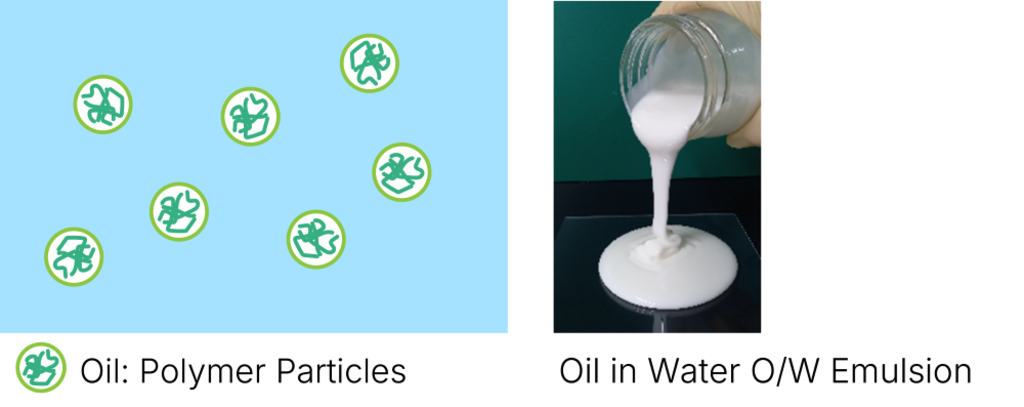
Acrylic emulsion is an emulsion in which acrylic polymer (the synthetic resin shown in the figure) is finely dispersed in water. It is mainly used in paints, adhesives, and coatings. Due to the precise product design of acrylic polymer, acrylic emulsion possesses excellent weather resistance, water resistance, and chemical resistance, forming a transparent film after drying.
Nippon Shokubai specializes in acrylic emulsion design technology. If you have any problems, please contact us here.
Explained in a video! Nippon Shokubai's acrylic emulsion
Characteristics of acrylic emulsion
1. Thixotropy
Thixotropy is the property of decreasing viscosity when a constant force is applied, such as when mixing, and returning to normal after a certain period of time. For example, this property is exhibited in products such as paints, where low viscosity makes them easier to apply.
2. Low viscosity even with high molecular weight
A feature of acrylic emulsion is that the molecular weight of the polymer inside the emulsion can be increased. As the polymer molecular weight increases, the entanglement between the polymers becomes stronger, resulting in better durability.
On the other hand, the higher the molecular weight of a typical polymer, the higher the viscosity it exhibits in solution.However, because the polymer in an emulsion structure has a rounded structure in the inner layer (oil layer) of the emulsion, it has the characteristic of being low viscosity and easy to handle even when the molecular weight is large, exceeding 1 million.
3. High degree of freedom in polymer design
It is possible to design a wide range of Tg, from approximately -100°C to 200°C, to achieve the desired hardness or softness. In addition, by selecting monomers with heat resistance, low moisture absorption, light stability, etc., it is possible to impart the desired functionality to the polymer.
4. The balance of physical properties can be varied to suit a wide range of applications
Acrylic polymers can be given a wider range of functions than urethane, epoxy, SBR, and vinyl acetate polymers.
Acrylic
Urethane
Epoxy
SBR
Vinyl Acetate
Chemical Resistance
○
◎
◎
○
×
Weather Resistance
◎
○
×
×
×
water resistance
○
◎
◎
○
△
water solubilization
○
△
△
○
○
Structural design for high performance acrylic emulsions
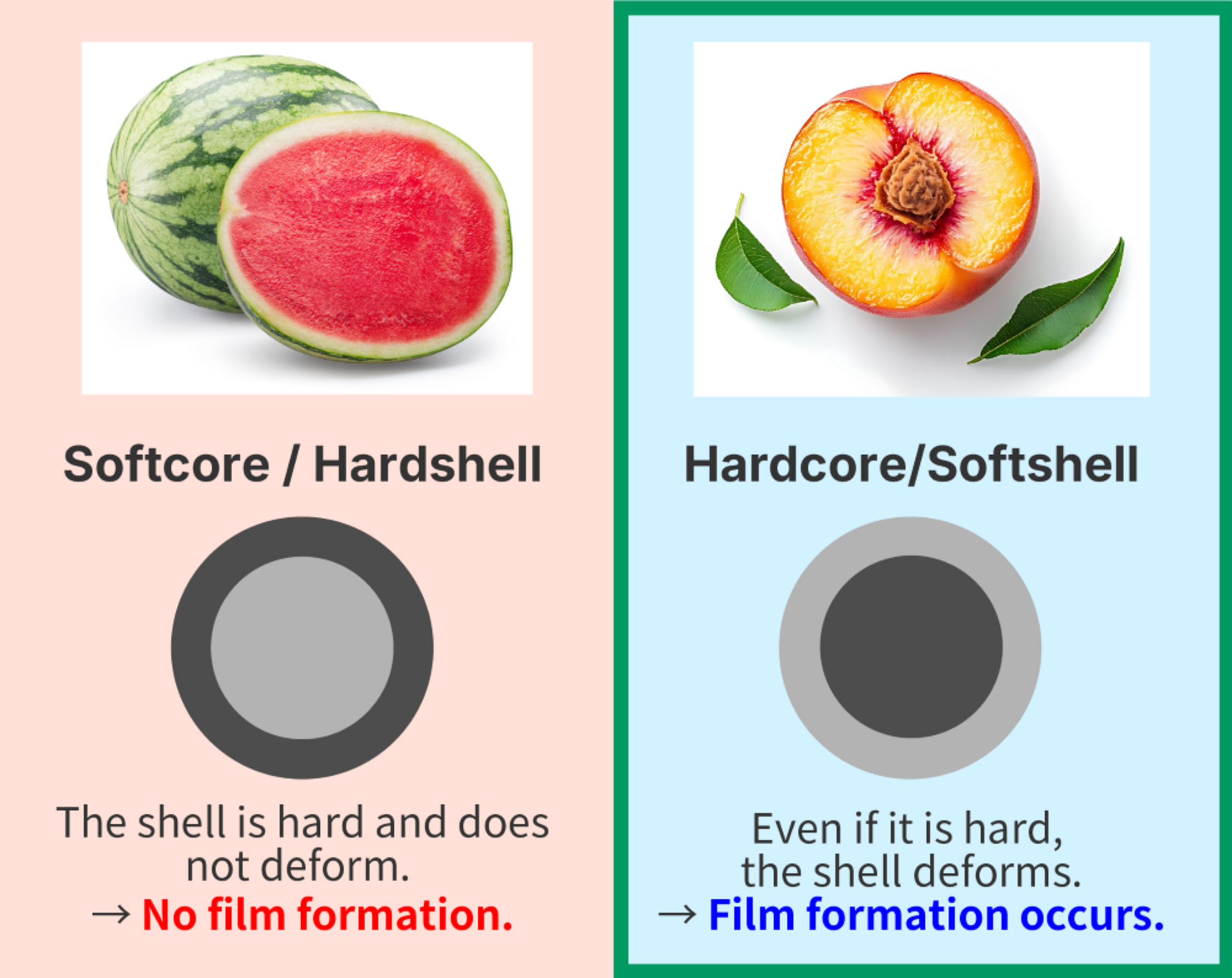
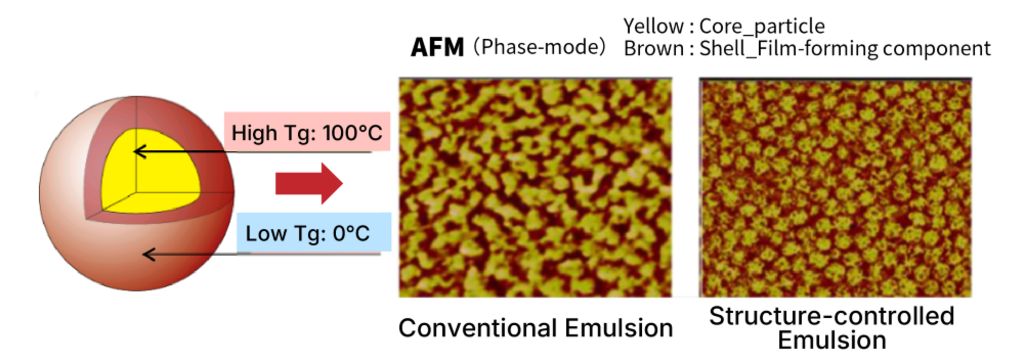
Nippon Shokubai 's acrylic emulsion has a core-shell structure, which is made up of two layers, with the core layer (inner) surrounded by the shell layer (outer).
There are two types of emulsions: hard core/soft shell, which is soft on the outside and hard on the inside, and soft core/hard shell, which is hard on the outside and soft on the inside. Nippon Shokubai 's emulsions have a structure (hard core/soft shell), where the outside is soft like the edible part of a ripe peach and the inside is hard like the peach pit, and have high film-forming properties.
Nippon Shokubai specializes in the technology to precisely control the structure of acrylic emulsions. By combining a low Tg (soft) polymer with a high Tg (hard) polymer in a shell shape, we can give the emulsion contradictory properties.
Polymer hardness and characteristics
polymer
Blocking resistance
Low pollution
stretch
Film formability
Low Tg
×
×
○
○
High Tg
○
○
×
×
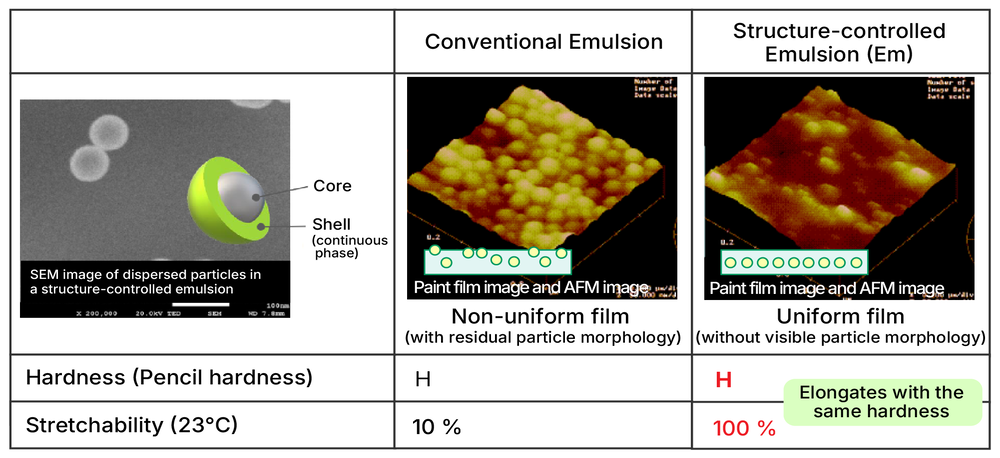
When the structure-controlled emulsion is applied to a coating, it forms an island-sea structure with a regularly arranged shell and core. It is possible to balance coating strength and flexibility.
Acrylic emulsion application examples
①Example of mixing into paint
Nippon Shokubai 's acrylic emulsion has a hard core/soft shell structure (hard inside, soft outside). This makes the structure less likely to break, and also makes it easier to apply a film and gives it strength, so it is incorporated into paints taking advantage of these characteristics.
By blending acrylic emulsions precisely designed using Nippon Shokubai 's design technology, it is possible to create a uniform film on water-based paints, just like solvent-based paints.
Coating properties
It is possible to design materials that achieve conflicting properties such as hardness (hardness, high Tg) and extensibility (softness, low Tg), as well as localize functional groups on the particle surface.
Acrylic emulsions are widely used in topcoat applications that have strict performance requirements. For example, they are expected to provide both blocking resistance and flexibility (softness) for use in construction material lines that require heat drying.
Furthermore, for building exteriors that require on-site painting, it is expected to offer both stain resistance (low tackiness) and stretchability.
Example of formulation for adhesive.
Acrylic emulsion is utilized as a binder resin in water-based adhesives. In applications such as masking tape, it is important to balance adhesive strength, holding power, tack, and re-peelability, which minimizes adhesive residue when removed.
The high design flexibility of acrylic emulsions allows for a well-balanced design of tackiness derived from softness and strength and holding power derived from hardness, according to performance requirements. Additionally, thanks to unique polymer design, it is also possible to improve issues that have plagued traditional water-based adhesives, such as "reduction of adhesive strength due to water absorption" and "whitening of the adhesive layer."