Explaining everything from the basics to applications of emulsion technology!
What is an emulsion?
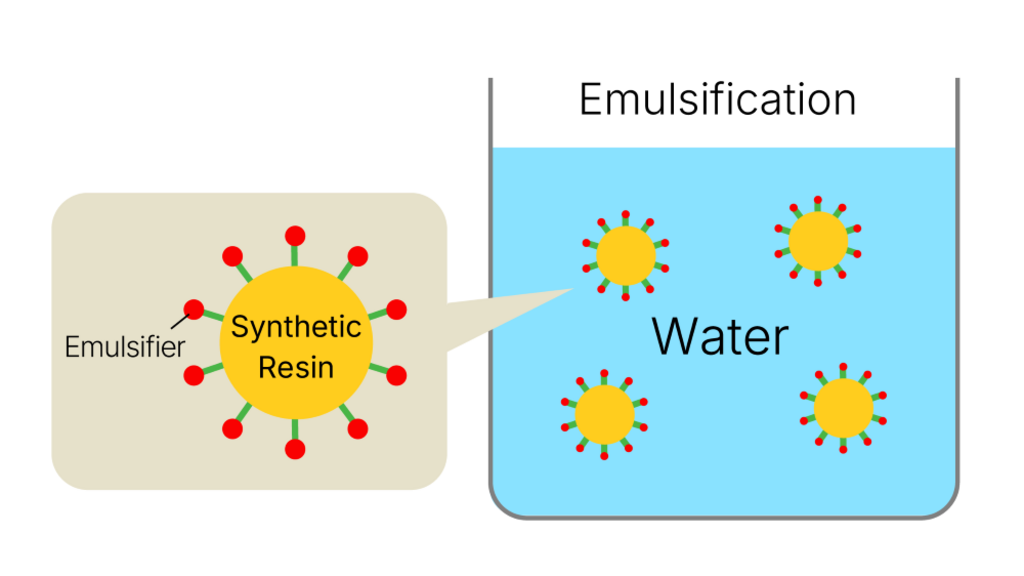
An emulsion is a system in which one liquid, such as water or oil, which is insoluble in the other, is dispersed in the form of very fine droplets (droplets) in the other liquid.
The emulsions developed and sold by Nippon Shokubai are liquids in which polymer particles, which are synthetic resins, are dispersed very finely and uniformly in water, with water serving as the continuous phase. Therefore, they are also calledpolymer Also called an emulsion.
Nippon Shokubai specializes in emulsion technology, particularly in acrylic emulsion design technology. For any emulsion-related inquiries, contact us here.
Emulsion Technology Video
What are applications of emulsion technology?
①Paints Inks & Coatings
Emulsion technology is used in architectural paints, industrial coatings, paper and textile coatings, and more, providing superior performance while reducing environmental impact.
Emulsion technology is used in many everyday cosmetics and personal care products, including creams, lotions, shampoos, and conditioners.
What are the advantages of emulsion technology?
1. Environmental Consideration
The use of emulsion technology can reduce the use of organic solvents and lighten the burden on the environment. This technology can be used to reduce VOC emissions, an effort that the manufacturing industry has been stepping up in recent years.
② Improved stability
Emulsion technology can stably mix liquids that normally do not combine, such as oil and water. By designing a highly stable state through emulsion technology, the long-term storage stability of products can be improved.
3) Low viscosity even with high molecular weight
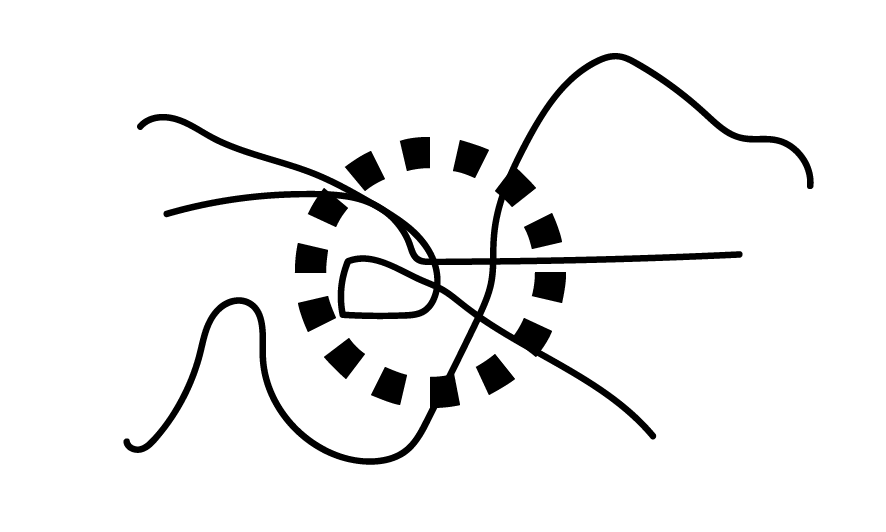
The polymer has a rounded structure in the inner layer (oil layer) of the emulsion, so viscosity does not depend on molecular weight.