A primer for civil engineering and construction refers to a preparatory material that is applied to the surface of a substrate, such as concrete, before the application of finishing materials like paint or self-leveling compounds.
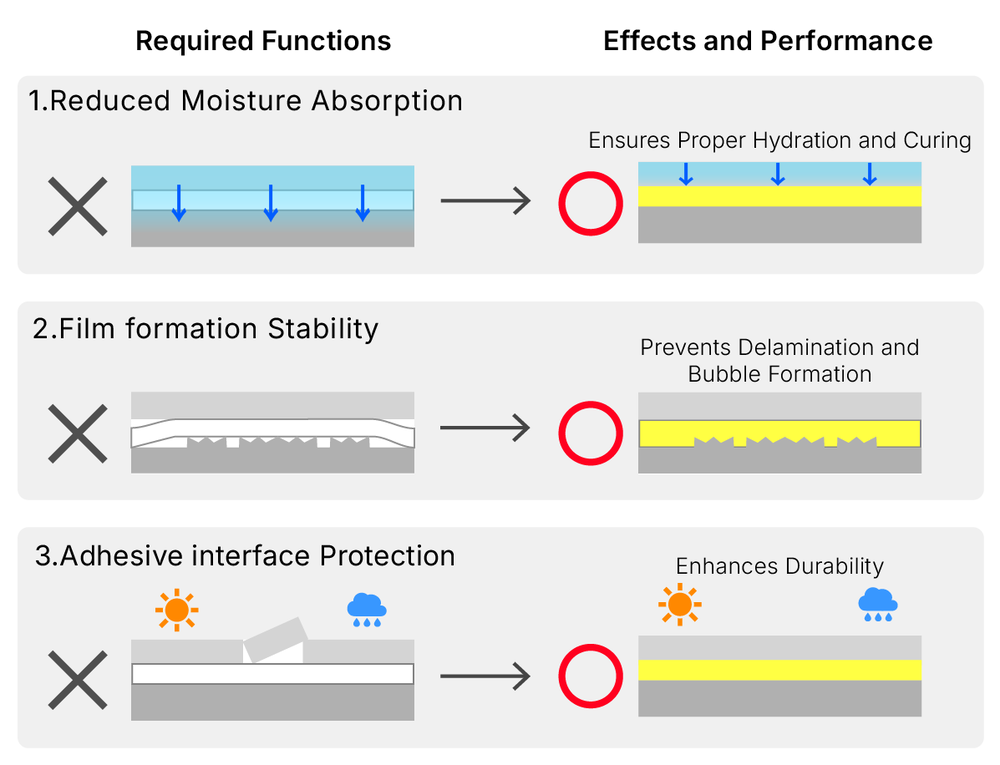
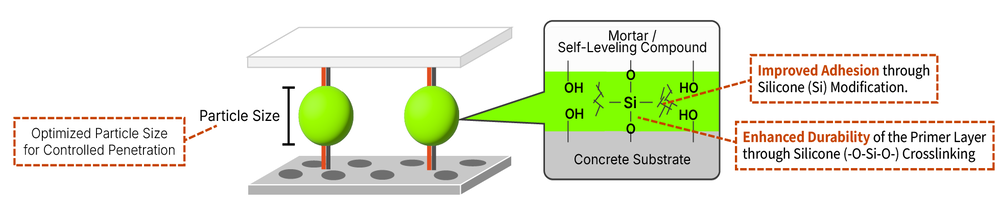
Primers are used to regulate the water absorption of concrete substrates, reinforce weak areas of the surface, and ensure stable adhesion with finishing materials and self-leveling compounds. They also suppress the upward migration of strong alkaline components contained in the substrate, reducing the deterioration and performance decline of the finishing layer. By allowing moderate penetration into the substrate and forming a uniform film, primers help minimize construction irregularities and bubble formation, contributing to stable performance even under varying construction conditions.
By using a primer specifically for flooring applications, moisture absorption from the concrete substrate can be suppressed, allowing the construction materials to fully exhibit their inherent performance. Furthermore, the compatibility with the substrate improves, and the increased contact area enhances adhesive strength, resulting in a stable finish that is less likely to peel.
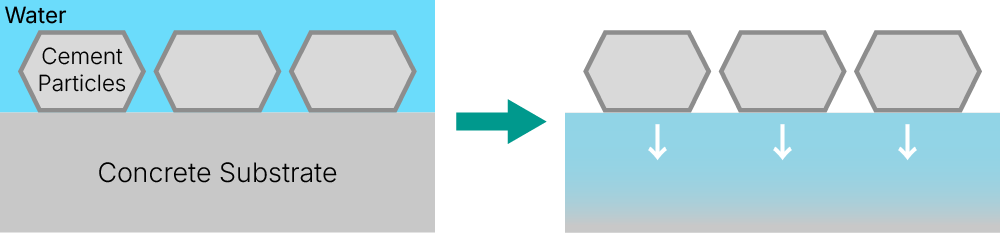
Without a Primer
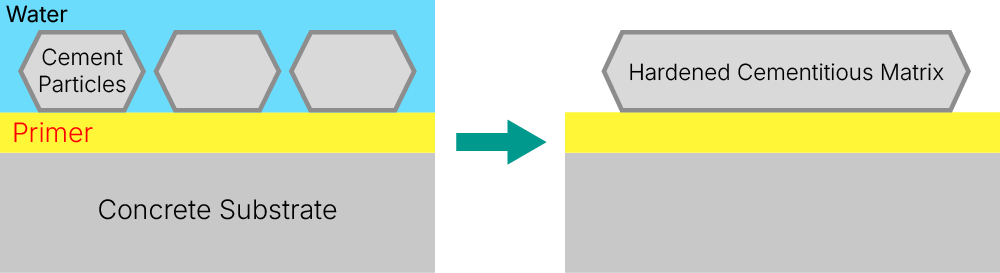
With a Primer
Water is absorbed into the substrate, causing poor curing (no reactive water available)
Water is present around the cement particles, increasing the bonding area to the substrate for sufficient curing.
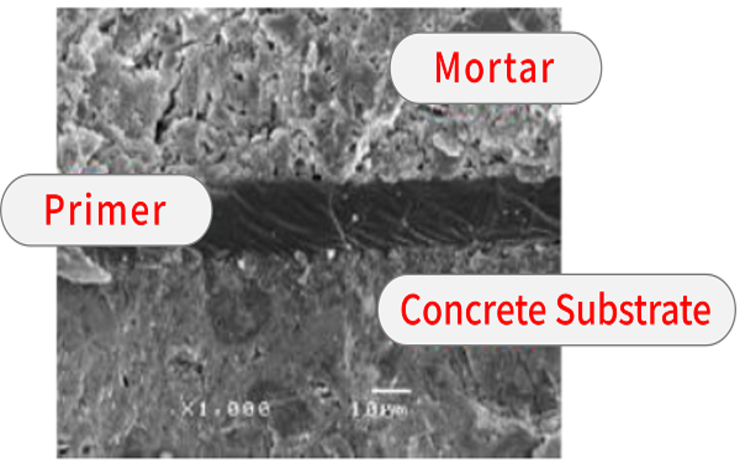
Bond the substrate and mortar closely to enhance adhesion strength. The primer controls the water absorption behavior of the substrate surface, retaining the necessary moisture around the cement particles.
Requirements for Concrete Primer
Primers for flooring materials used in civil engineering and construction are primarily employed to improve the quality of the flooring materials. They are designed to enhance the quality of flooring installation and to create floors that are resistant to various deterioration factors.
The silicone-modified acrylic emulsions ACRYSET CE-518 and CE-553 are formulated as primers for mortar and self-leveling materials (SL materials). Due to the ingenuity in resin design, it is expected to appropriately control permeability to the substrate while improving adhesion and durability. The monomer compositions of CE-518 and CE-553 differ, with designed glass transition temperatures (Tg) of -12°C and -21°C, respectively.
Physical properties of emulsions (representative values)
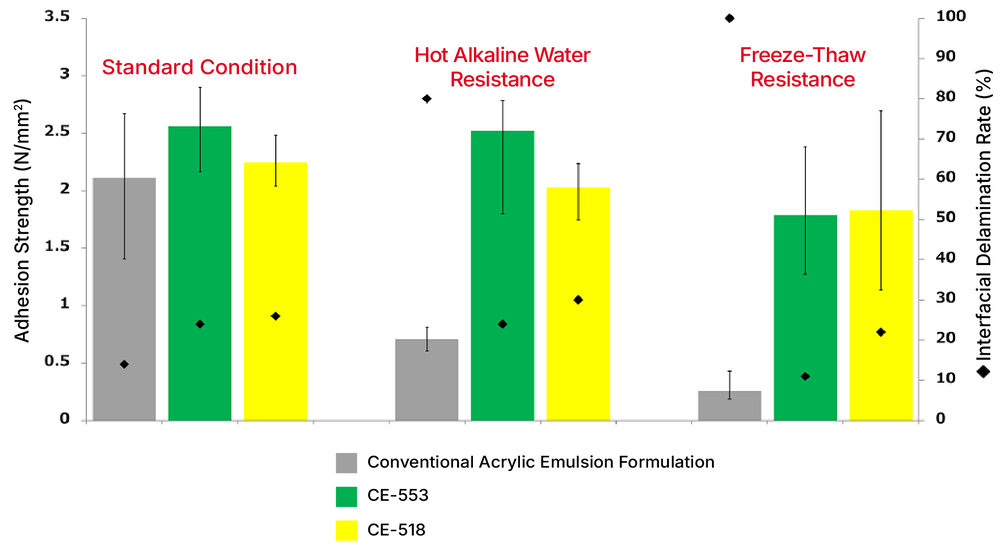
1. Capable of demonstrating adhesion even in harsh environments.
Good adhesion was confirmed in water resistance, freeze-thaw resistance, and hot alkaline water resistance tests.
Using SL (self-leveling) material, confirm its performance as a primer.
The adhesion strength was evaluated in accordance with the Standard Specification M-101 of the Society of Finishing Technology of Japan.
Adhesion Strength Test Method (Evaluated with Kenken Type Tensile Testing Machine) Base Material: Concrete Board Primer Application Amount: 22.5g/m2 Primer Curing: 1 Day Top Material: Mortar (w/c=0.39) Basic Curing: 28 Days (20°C, 80% 2 Days → 20°C, 50% 26 Days)
Normal Condition: Adhesion Strength Test After Basic Curing Heat-Resistant Alkaline Water: After Basic Curing, Cured in Saturated Calcium Hydroxide Solution at 80°C for 28 Days Freeze-Thaw Resistance: After Basic Curing, 20°C for 15 Hours → -20°C for 3 Hours → 60°C for 6 Hours for 50 Cycles
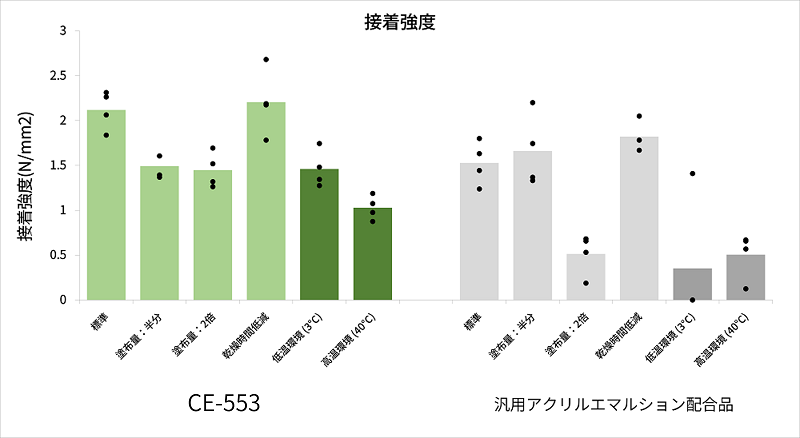
2. Exhibits stable adhesion strength under various application conditions.
CE-553 exhibits stable adhesion strength even when the application rate varies or under temperatures ranging from low to high.
Conditions for the application test of the sample.
Test No.
Test conditions
1
standard
2
Amount of application: half
3
Application amount: double
4
Reduction of drying time
5
Low temperature environment (3°C)
6
High temperature environment (40°C)
Test conditions
Cycle test under the following conditions (20 times)
Test results
Test results in a low-temperature environment (3°C)
Cold (3°C)
CE-553
General-purpose acrylic emulsion blend
Substrate destruction: ○
Interface destruction
Test results in a high-temperature environment (40°C)
Hot (40°C)
CE-553
General-purpose acrylic emulsion blend
Substrate destruction: ○
Interface destruction
Examples of intended uses for civil engineering and construction emulsions (ACRYSET™ CE-518 / CE-553)