A refractive index of 1.86 and maintains high transparency without color even after the formation of the optical layer! Zirconia nanoparticle dispersion (ZIRCOSTAR™)
What is a high refractive index material (ZIRCOSTAR™)?
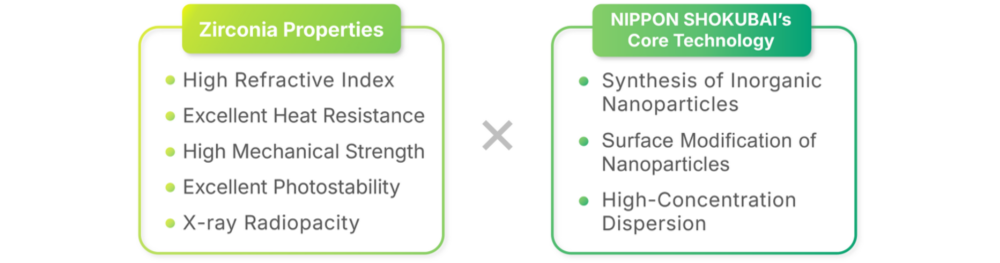
ZIRCOSTAR is a dispersion of zirconia nanoparticles that stably disperses inorganic particles with a high refractive index. Since the particles themselves have a high refractive index of up to 1.86, adding them to a resin allows for efficient control of the refractive index of the dispersion and the optical layer that is ultimately formed.
After the formation of the optical layer, it maintains high transparency and is colorless, and the refractive index can be optimized based on the refractive indices of the particles and binder resin, as well as their mixing ratios.
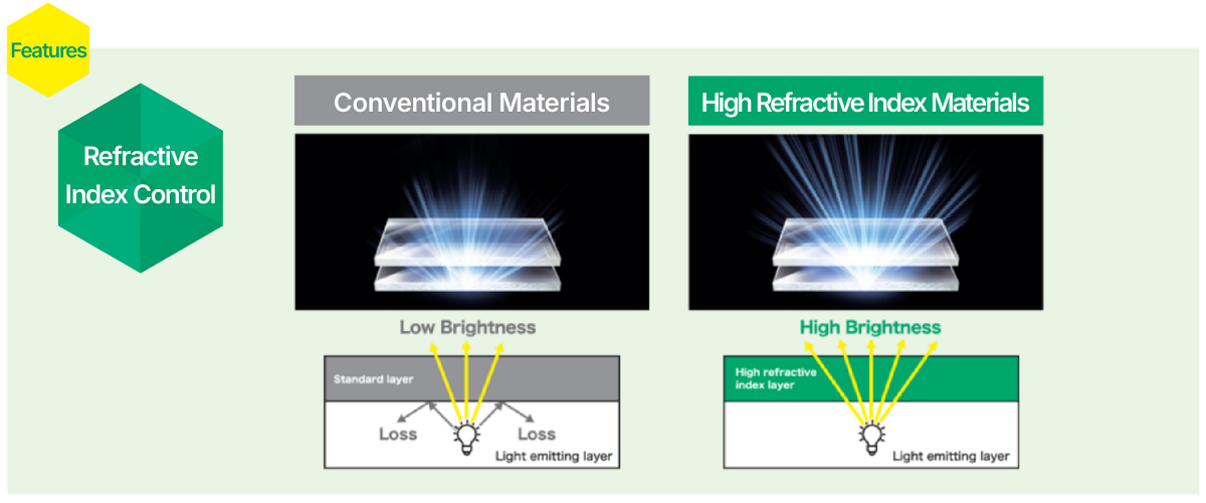
Image diagram of refractive index control in high refractive index materials.
By using high refractive index materials, the direction of light traveling within the layer can be controlled, which improves the efficiency of light extraction to the outside. As a result, light loss is minimized, and higher brightness is achieved.
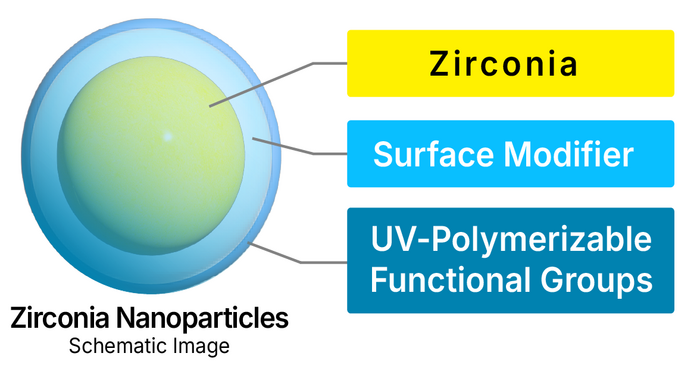
Illustration of zirconia nanoparticles by Nippon Shokubai.
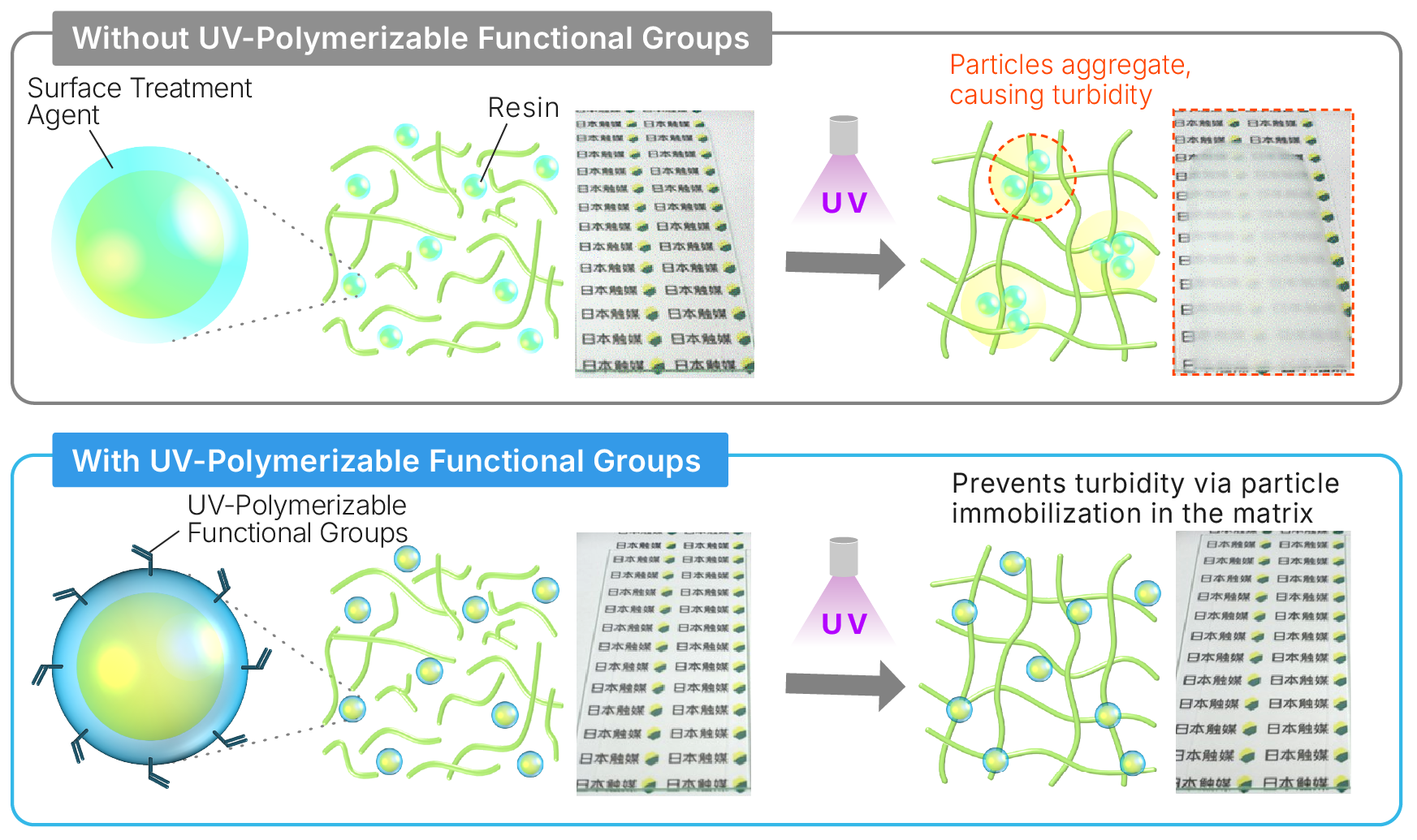
The zirconia nanoparticles synthesized by Nippon Shokubai using a unique method have a nanoscale particle size and achieve a high refractive index. The particle surfaces are uniformly and highly coated to improve dispersion, and furthermore, UV polymerizable functional groups are introduced on each particle surface to effectively suppress aggregation during the light curing process.
Lineup of high refractive index materials (ZIRCOSTAR™)
You can choose from multiple lineups according to the refractive index, intended purpose, and application. There are solvent dispersion types and solvent-free monomer dispersion types available.
solvent dispersion type
ZP-153
Type LP (development product)
standard product
High refractive index products
dispersing medium
Methyl ethyl ketone (MEK)
Propylene glycol monomethyl ether (PGM)
Particle content rate
70 weight percent
70 weight percent
Viscosity (20°C)
10 mPa·s
70 mPa·s
Refractive index of particles
1.78
1.86
Average particle size
11 nm
18 nm
Crystal system
Cubic crystal (main crystal system)
Monomer dispersion type (solvent-free)
HR-101
HR-301
HR-LP-1
HR-LP-2
standard product
High refractive index products
developed product
developed product
dispersing medium
Benzyl acrylate
High refractive index Acrylic monomer
Benzyl acrylate
High refractive index Acrylic monomer
Viscosity (20°C)
3,000 mPa·s
80,000 mPa·s
500 mPa·s
40,000 mPa·s
Refractive index of dispersion liquid
1.66
1.69
1.70
1.75
Average particle size
11 nm
11 nm
18 nm
18 nm
Crystal system
Cubic crystal (main crystal system)
Characteristics of High Refractive Index Material (ZIRCOSTAR™)
1. Achieving both a high refractive index (approximately 1.86) and colorless transparency.
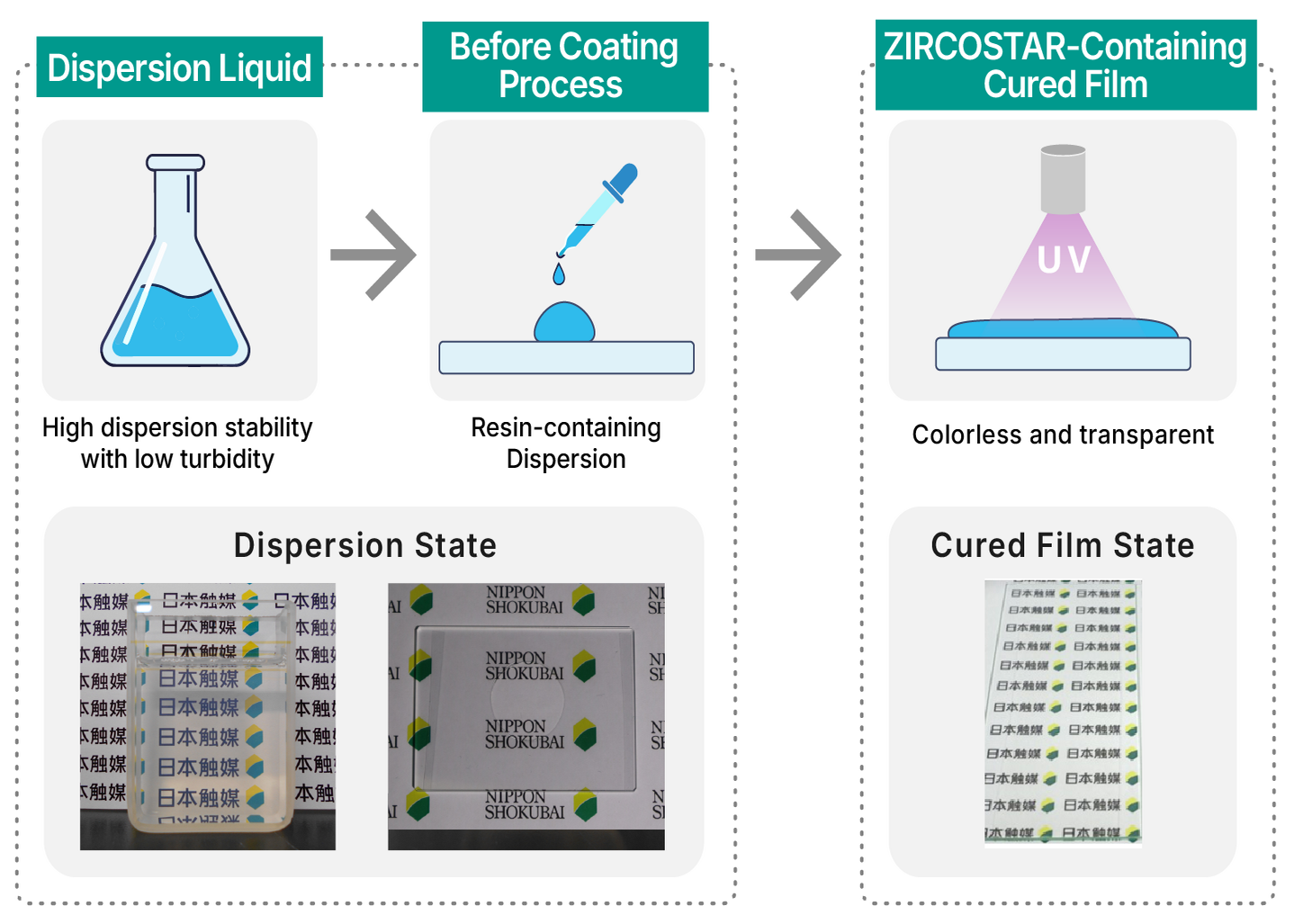
ZIRCOSTAR, a high refractive index transparent material with a high refractive index (~1.86) and colorless transparency, shows high dispersion stability as a dispersion liquid, and after being blended with resin and forming a cured film, it exhibits colorless and high transparency.
The mechanism that can maintain transparency after the formation of the optical layer.
The technology for stabilizing the dispersion of nanoparticles by introducing UV polymerizable functional groups suppresses particle aggregation during the UV curing process and maintains high transparency even after UV curing.
Establishment of technology for the stabilization of nanoparticle dispersion in resin.
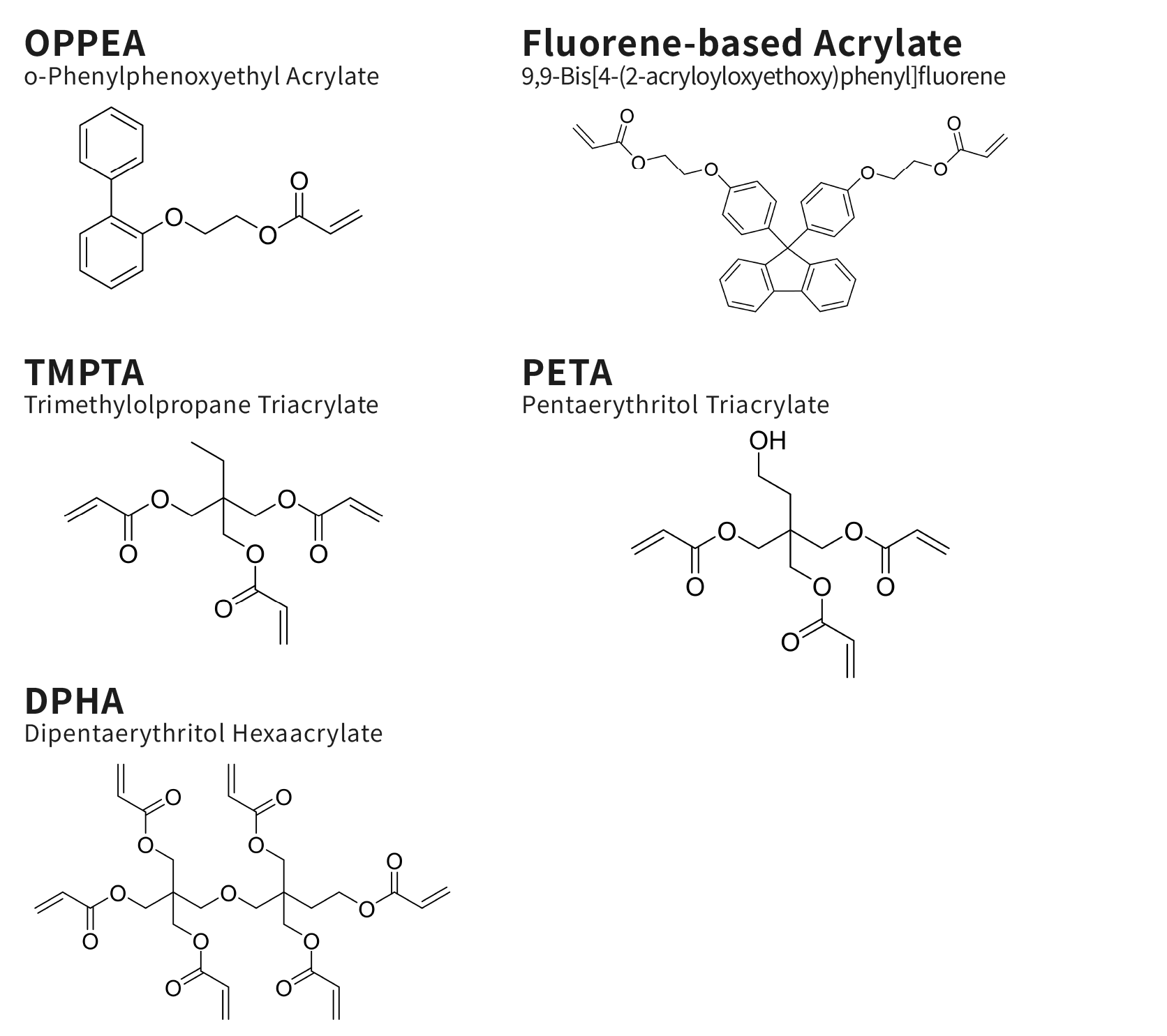
2. Good dispersion of aromatic acrylates and multifunctional acrylates.
It is well dispersed in various aromatic acrylates and multifunctional acrylates in all types.
3. Usable in overseas regions (inventory registration status) *excluding development products
In some overseas regions, including Japan, there is a registration for the chemical inventory or it is in a state that allows for export. For regions not listed, please contact us.
Japan (Chemical Substances Control Law)
Taiwan (TCSI)
South Korea (KECL)
China (IECSC)
United States (TSCA)
Registered
Registered
Unregistered (exportable) *1
Registered
Registered
*1: Prior registration as an importer is required (lead time of about one month).
Examples of applications for high refractive index materials (ZIRCOSTAR™)